
Ask These 5 Supplier Questions: SIP vs VoIP for UK Businesses
23 September 2026
Ask These 5 Supplier Questions: SIP vs VoIP for UK Businesses
VoIP is the transport layer: it carries voice as data over an internet connection instead of a copper line. SIP is the signalling protocol that sets up, manages and ends those calls, and SIP trunking is the specific service that connects an existing PBX to the public phone network over IP. Choose hosted VoIP if you want to retire an ageing PBX and hand maintenance to a provider; choose SIP trunking if your PBX still earns its keep and you’re migrating away from ISDN. Either way, check emergency-call routing and resilience before you sign anything.
TL;DR:
- Hosted VoIP is ideal for small businesses without a legacy PBX, offering quick deployment and provider-managed platform updates at a predictable monthly cost.
- SIP trunking suits larger, multi-site organizations with ongoing PBX investment, providing cost-effective channel-based pricing and better integration with existing telecom infrastructure.
- Both services depend heavily on reliable broadband and mains power; planning for dual circuits, backup routing, and tested failover options is essential to ensure emergency call connectivity.
- Before migration, inventory all PSTN-dependent devices and verify PBX compatibility, call volume patterns, and the provider’s emergency call handling during outages.
- Asking suppliers about SLA guarantees, redundancy, emergency call testing, and failover architecture is critical to avoid risks and ensure resilience after switching to IP telephony.
Table of Contents
- What is VoIP and how does hosted VoIP work?
- What is SIP and how does SIP trunking work?
- Hosted VoIP vs SIP trunking: the practical trade-offs
- Resilience, emergency calls and the risks people miss
- How to choose: a checklist and the questions to ask suppliers
- Why Essex Telephone Systems is a practical option for this decision
- An editorial view on getting this decision right
- Ready to move from comparison to a working phone system?
- Sources
- FAQ
What is VoIP and how does hosted VoIP work?
VoIP simply means voice carried as digital data over an IP network rather than a dedicated telephone circuit. Two things happen at once on every call: the audio itself travels as small packets using Real-time Transport Protocol (RTP), while a separate signalling layer, usually SIP, handles the actual business of setting the call up, connecting it and hanging it up. People often collapse these into one idea. They’re not the same job.
Hosted VoIP is where most businesses actually meet this technology. Instead of a physical PBX cabinet in a comms cupboard, the phone system lives in the provider’s cloud, and your office connects to it over broadband using handsets, soft-clients on laptops, or mobile apps. The provider handles the platform, the updates and most of the plumbing.
What typically comes with a hosted VoIP service:
- Call queuing, auto-attendants, voicemail-to-email and call recording built in as standard features rather than paid add-ons
- A management portal so you can add users, change hunt groups or reroute numbers without calling an engineer
- Handset flexibility, from cheap desk phones to soft-clients that turn any laptop into an extension
- Subscription pricing per user per month, which is easier to budget than capital spend on PBX hardware
The trade-off is dependency. Hosted VoIP relies entirely on your broadband connection and mains power at the site. Lose either and the phones go with it, which is exactly why resilience planning matters later in this guide. When you’re comparing VoIP options against your current setup, ask specifically what happens during a broadband outage, not just what happens on a good day.
What is SIP and how does SIP trunking work?
SIP, the Session Initiation Protocol, is the signalling standard defined in RFC 3261 and covered in ITU recommendations, and it’s what actually negotiates a call. When you dial a number, SIP messages such as INVITE, ACK and BYE travel between systems to open the session, confirm it and close it down again once the call ends. It’s the traffic controller, not the traffic itself.
SIP trunking applies that protocol to a specific job: connecting an IP-enabled PBX or session border controller (SBC) to the public telephone network, replacing the old ISDN lines that used to do this. Rather than physical circuits into the building, you get a virtual trunk carrying a set number of concurrent calls, often called channels.
What to check before choosing SIP trunking:
- Channel capacity: how many simultaneous calls the trunk supports, and what happens when you exceed it
- PBX and SBC compatibility, since older on-premises systems may need firmware updates or additional hardware
- Number porting for your existing DDIs, and the timeline the supplier commits to
- Failover and geographic diversity options, which Digital Marketplace SIP trunking specifications list as standard features worth comparing across suppliers
SIP trunking suits organisations with a PBX still under its useful life, and it’s also the standard route for Direct Routing into collaboration platforms where you want to keep your own number ranges rather than porting into a fully hosted service.
Hosted VoIP vs SIP trunking: the practical trade-offs
The decision usually comes down to four things: who owns the maintenance headache, what it costs, how much feature parity you need, and how the setup scales as you grow.
-
Ownership and troubleshooting. With hosted VoIP, the provider patches the platform, manages uptime and generally owns first-line fault-finding. With SIP trunking, you (or your IT support) still own the PBX, meaning firmware updates, codec configuration and on-site troubleshooting stay your responsibility, even though the trunk itself is the provider’s problem.
-
Cost structure. Hosted VoIP tends to price per user per month, bundling features into that fee. SIP trunking prices by channel, so a business with 40 staff but only 12 simultaneous external calls at peak can often run cheaper trunking than per-seat licensing, according to Digital Marketplace service comparisons. Factor in porting and migration costs on both sides. Neither is free to set up.
-
Feature depth vs. custom integration. Hosted platforms generally ship with call queuing, CRM integrations and analytics baked in. SIP trunking preserves whatever custom PBX configuration you’ve already built, which matters if you’ve spent years tuning call routing or integrating with a bespoke system you don’t want to rebuild from scratch.
-
Scalability. Hosted VoIP scales by adding user licences, which is simple but can get expensive at volume. SIP trunking scales by adding channels, which suits businesses with predictable, high call volumes but low headcount, such as contact centres. If you’re bursting unpredictably, ask suppliers how they handle temporary channel increases and what that costs.
Smaller, single-site businesses without a heavy PBX investment usually find hosted VoIP the simpler commercial fit. Larger organisations with an established PBX estate, particularly across multiple sites, often get more value from SIP trunking, at least as a staging point before any full migration.
Resilience, emergency calls and the risks people miss
Every IP voice service depends on two things a traditional landline didn’t: your broadband connection and your mains power. Ofcom’s guidance on the migration from PSTN to VoIP is blunt about this: if your internet or power goes down completely, your 999 calls may not get through unless you’ve planned an alternative route. That’s a genuinely different failure mode from the old copper network, which kept working through a power cut because the exchange fed the line.
Build resilience in deliberately, rather than assuming the provider has it covered:
- Dual access circuits or a second broadband connection from a different provider, so one failure doesn’t take out both
- 4G or 5G backup routing that kicks in automatically when the primary line drops
- Redundant SBCs and geographically diverse points of presence, both listed as configurable options in SIP trunking service specifications
- A documented, tested failover plan, not just a claim in a sales brochure
Migration risk goes well beyond swapping handsets, too. Alarm panels, lift phones, payment terminals and door-entry systems often rely on PSTN line power or specific line characteristics that IP services don’t automatically replicate. Inventory every device on the old line before you switch, not after.
Pro Tip: Ask any supplier to demonstrate an emergency call under a simulated outage before you sign, not just describe how it should theoretically work. If they can’t show you, that’s your answer.
How to choose: a checklist and the questions to ask suppliers
Start with an inventory, not a quote. Before comparing providers, you need to know what you’re actually migrating.
- List every PSTN-dependent device on site: alarms, telemetry, card machines, lift phones, fax lines and door entry.
- Check your PBX model and firmware version if you’re keeping it, and confirm the manufacturer still supports SIP connectivity.
- Calculate required concurrent channels, not total users, based on genuine peak call volume rather than a guess.
- Map call volume patterns across the day and year, particularly if you have seasonal spikes.
- Shortlist suppliers against the questions below rather than price alone.
Questions worth putting directly to any supplier:
- How is emergency call routing handled if our primary connection fails?
- Who manages number porting, and what’s the realistic timeline?
- What are the SLA figures for availability, latency, jitter and packet loss, in writing?
- What’s the incident response time if voice quality degrades during business hours?
- What fraud controls are in place, and are they included in the price or billed separately?
| Business profile | Usual best fit | Why |
|---|---|---|
| Small, single-site, no legacy PBX | Hosted VoIP | Lower complexity, provider manages the platform, quick to deploy |
| Established PBX still within its lifespan | SIP trunking | Preserves existing investment and integrations while dropping ISDN |
| Multi-site with high call volume, low headcount | SIP trunking | Channel-based pricing usually beats per-user licensing at volume |
| Growing business planning to scale headcount fast | Hosted VoIP | Per-user licensing scales predictably as staff numbers rise |
Why Essex Telephone Systems is a practical option for this decision
Essex Telephone Systems covers both sides of this choice directly, offering VoIP & SIP hosted telephony, leased lines for resilient connectivity, and 4G/5G backup routers for failover. That range matters because the right answer genuinely depends on your PBX status and site count, not a one-size pitch.
What the company brings to the migration checklist above:
- Site surveys that identify PSTN-dependent devices before migration, not after
- Network cabling installation and wifi survey work where the physical infrastructure needs attention first
- UK-based support for faster issue resolution once you’re live
- No long-term contract lock-in on core services, giving you room to adjust as needs change
Before any contract, verify specific SLA numbers, redundancy design and emergency-call handling in writing during the sales conversation. General reputation is no substitute for seeing actual failover architecture on paper.
An editorial view on getting this decision right
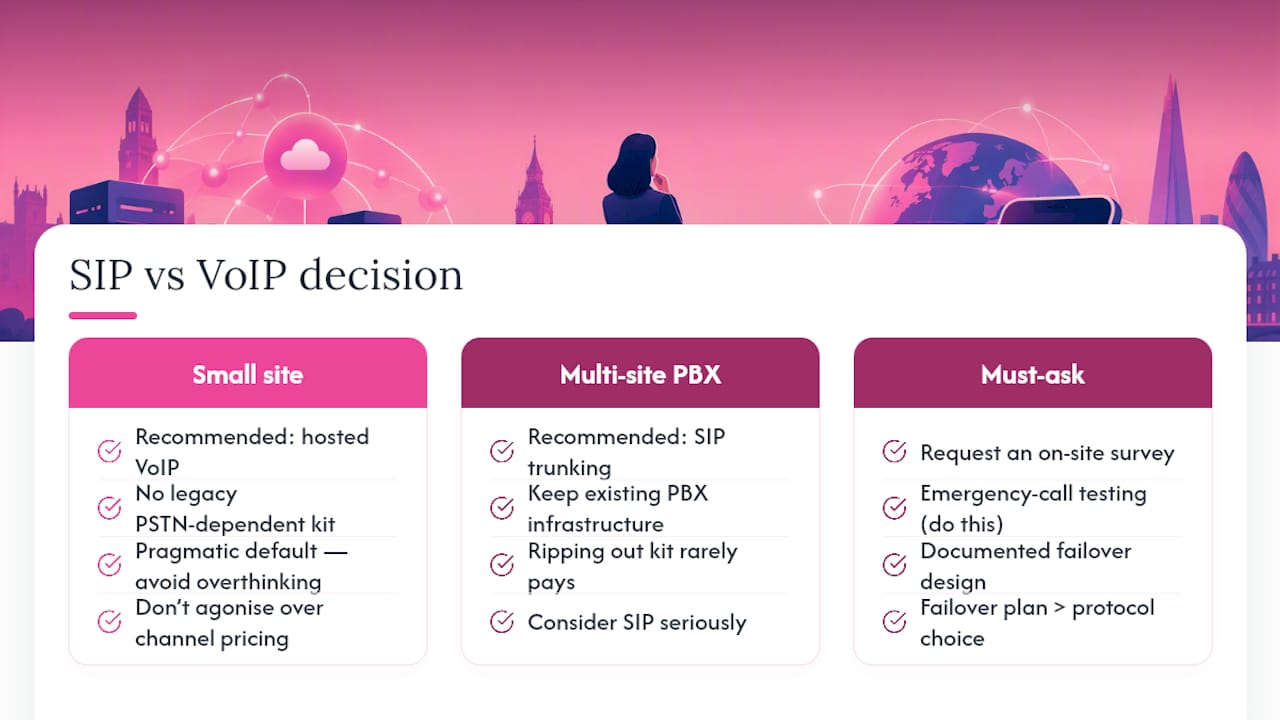
Most businesses overthink the SIP versus VoIP framing and underthink resilience, which is backwards. The protocol choice rarely breaks a business; a broadband outage with no failover plan does. If you’re a small, single-site operation without legacy PSTN-dependent kit, hosted VoIP is usually the pragmatic default; don’t spend weeks agonising over channel-based pricing models that only make sense at volume.
If you’re running an established PBX across multiple sites, SIP trunking deserves serious consideration precisely because ripping out working infrastructure rarely earns its cost. Either way, request an on-site survey before signing anything, and make emergency-call testing and documented failover design the two questions you refuse to skip, regardless of how good the sales pitch sounds.
— Paul
Ready to move from comparison to a working phone system?
A practical alternative to guessing your way through a PBX replacement or SIP migration is to get a site survey that tells you which option actually fits your building, call volumes and existing kit.
The services map directly onto the decisions covered in this guide. VoIP & SIP hosted telephony covers both routes discussed above, broadband and fibre options underpin the resilience design your provider should be offering, and leased lines give larger sites a dedicated, high-availability circuit rather than relying on shared bandwidth. For businesses juggling alarms, telemetry or other PSTN-dependent kit, the telecoms property management service handles that inventory work before anything gets switched off. If you’re weighing subscription costs against your current setup, providers like RevRing publish hosted VoIP pricing worth benchmarking against.
The next step is straightforward: get a technical survey booked. Bring your PBX model, current channel usage and a list of anything on-site that still depends on the old phone line, and Essex Telephone Systems will tell you plainly which route fits, not which one is easiest to sell.
Sources
- ITU — SIP / related standards and recommendations
- SIP trunking service description — Digital Marketplace
FAQ
Is SIP considered VoIP?
SIP is part of the broader VoIP category rather than a separate technology competing with it. VoIP describes voice carried over an IP network in general, while SIP is the specific signalling protocol that sets up and tears down those calls.
Is a SIP phone better than a regular phone?
A SIP phone connects to an IP network and typically offers more built-in features, such as call forwarding and multiple line support, than a traditional analogue handset. The trade-off is dependency on power and internet connectivity, which a standard landline historically didn’t share.
Is a SIP phone the same as an IP phone?
They’re effectively the same thing in practice, since most IP phones use SIP as their signalling protocol to register and manage calls. A handset described as either “SIP phone” or “IP phone” is almost always referring to the same category of device.
Is the SIP protocol still used?
Yes, SIP remains the standard signalling protocol underpinning most business VoIP and SIP trunking services, with ITU and IETF standards still governing conformance and interoperability. It’s the foundation for everything from hosted PBX platforms to Direct Routing into collaboration tools.
What does Essex Telephone Systems charge for VoIP or SIP services?
Pricing for VoIP & SIP hosted telephony isn’t published as a flat rate, since it depends on user numbers, channel requirements and existing infrastructure. Current broadband plans start from £24 per month, and full telephony pricing is available directly through the site.