T.38 vs G.711: Fix Fax over VoIP for Essex Businesses
17 September 2026
T.38 vs G.711: Fix Fax over VoIP for Essex Businesses
Fax over VoIP works, but only when you get the transport method right. The safest routes are end-to-end T.38 support or a cloud fax service; anything relying on raw G.711 passthrough between mismatched providers is a coin toss. Choose T.38 relay where both ends genuinely support it, or switch to fax-to-email for anything business-critical, because signalling mismatches and network jitter are what actually break most fax calls.
TL;DR:
- T.38 demonstrates high success rates even under adverse network conditions, but it demands genuine support at all network points; otherwise, failure is inevitable.
- Start with a thorough network assessment to measure packet loss and jitter, confirming that the provider and equipment support T.38 before deploying it.
- For high-volume or regulated workflows, a dedicated analogue line remains the most dependable option, while cloud fax is ideal for low-stakes or occasional use.
- Troubleshooting should focus on verifying support, examining SIP re-INVITE exchanges, and monitoring network stability before considering a switch to alternative methods.
Table of Contents
- What is fax over VoIP and how do T.30, T.38 and G.711 differ?
- Which practical FoIP setup should you actually use?
- What network and PBX settings does reliable FoIP need?
- How do you troubleshoot a failed fax over VoIP call?
- When should you stop troubleshooting FoIP and switch approach?
- How Essex Telephone Systems approaches fax reliability for business clients
- How Essex Telephone Systems solves fax reliability properly
- Standards and testing guidelines worth reading next
- Sources
- FAQ
What is fax over VoIP and how do T.30, T.38 and G.711 differ?
Fax over IP, or FoIP, means carrying a fax call across a VoIP network instead of a traditional phone line. The complication is that fax was never designed for packet networks, and three very different transport approaches now compete to carry it.
T.30 is the original analogue fax protocol, built for the tight, predictable timing of the public switched telephone network. It expects tones and handshakes to arrive within strict windows, which a VoIP link with variable delay routinely violates. Run T.30 raw over an IP path with no fax-aware handling, and long documents often fail.
T.38 solves this by demodulating the fax signal at the gateway and sending it as structured data over UDPTL rather than as audio. It adds redundancy and forward error correction, so lost packets do not automatically kill the call. Testing shows T.38 in redundancy mode achieving a very high success rate for single-page faxes even under adverse network conditions, while raw T.30 over IP for documents beyond 20 pages barely succeeds at all.
G.711 passthrough takes the opposite approach: it treats the fax tones as ordinary audio and tries to carry them uncompressed through the voice codec. It can work on a clean, low-latency network with no transcoding in the path, but it is fragile the moment jitter buffers, echo cancellers, or a second codec hop get involved.
- T.30 over IP (no FoIP support): fails on anything but the shortest documents; avoid entirely.
- T.38 relay: the most robust option; tolerates packet loss well; requires both endpoints to support it.
- G.711 passthrough: viable only on pristine, low-jitter networks with no transcoding.
Which practical FoIP setup should you actually use?
Four realistic paths exist, and the right one depends on volume, compliance needs, and how much technical control you have over the network.
- Cloud fax (fax-to-email). Documents arrive and depart as email attachments via a hosted service, bypassing the unreliable RTP path entirely. This sidesteps the core problem: it removes the need for every interconnect in the chain to be fax-aware, and it typically gives you audit trails and delivery confirmation that support compliance requirements for regulated documents.
- An ATA with a T.38-capable provider. This can work well, but only if T.38 support is genuine end-to-end: your analogue telephone adapter, your PBX or gateway, and your provider’s SIP trunk all need to negotiate T.38 successfully. Practitioners are consistent on this point: adding an ATA alone rarely fixes anything if one link in that chain still forces G.711.
- G.711 passthrough as a fallback. Acceptable for low-stakes, occasional faxing on a network you control tightly, with no third-party transcoding. Treat it as a stopgap, not a strategy.
- A dedicated POTS/analogue line. Still the right call for very high-volume fax traffic or workflows with strict legacy regulatory requirements, where any FoIP failure rate is unacceptable.
What network and PBX settings does reliable FoIP need?
Fax is far less tolerant of network flaws than voice calls, so the targets are tighter. Practical thresholds worth working to: keep packet loss very low and minimize jitter during the transmission window, since these are the levels practitioners flag as the usual culprits behind intermittent failures rather than hard guarantees of success.
Codec configuration matters as much as raw bandwidth:
- Enable T.38 on your PBX and SBC or gateway wherever the far end supports it; fall back to G.711 only when it doesn’t.
- Disable silence suppression (VAD) and echo cancellation on any leg carrying fax traffic. Both are designed for voice and actively corrupt fax tones.
- Use fixed jitter buffers rather than adaptive ones for fax calls where possible.
Your SBC and PBX need to handle the T.38 re-INVITE cleanly, the mid-call signal where the gateway asks to switch from an audio codec to T.38 once it detects fax tones. A B2BUA that correctly normalises SIP and SDP between mismatched vendors makes this switch far more dependable, and its call logs are the first place to check when a fax fails silently.
Firewalls and NAT devices are a common hidden cause of failure. Confirm that re-INVITE requests and UDPTL packets aren’t being dropped or mangled, and check whether a SIP ALG on your router is rewriting headers in ways that break the handshake.

Pro Tip: If you manage your own SIP trunk, ask your provider in writing whether T.38 is supported end-to-end on that specific trunk, not just “supported by the platform” — the two are not the same thing, and the gap between them is where most FoIP projects fail.
How do you troubleshoot a failed fax over VoIP call?
Work through this in order rather than guessing at settings:
- Confirm your provider actually supports T.38 on your trunk, and confirm the remote fax machine’s provider does too. One-sided support guarantees failure on longer documents.
- Send a single-page test fax first. If that succeeds but multipage documents fail, the issue is almost certainly timing or jitter accumulating over the call.
- Pull a SIP trace and look for whether the T.38 re-INVITE actually appears and gets accepted, or whether you see a 415 Unsupported Media Type response, which means the far end rejected the switch.
- If the call stays on G.711 throughout, check for unexpected codec renegotiation mid-call, a classic sign of a transcoding device in the path.
- Run packet loss and jitter monitoring during the actual failure window, not just as a general health check, and capture RTP statistics from your SBC logs.
Pro Tip: Common failure modes reported in carrier testing include failed re-INVITEs during tone detection and unwanted transcoding in the call path, exactly the pattern that interconnect-level testing keeps surfacing between carriers with mismatched fax handling.
If your network is genuinely clean, forcing G.711 mid-call can be a legitimate short-term fix. If it isn’t, or you can’t verify it quickly, moving to cloud fax solves the problem immediately rather than eventually.
When should you stop troubleshooting FoIP and switch approach?
Fax often breaks before voice does on a struggling connection, working as an early warning sign of underlying network problems rather than a fault in its own right. That’s worth remembering before you spend days chasing a fax issue that’s actually a wider connectivity problem.
Run through this before committing further time to FoIP:
- Volume: occasional to moderate fax traffic favours cloud fax; only genuinely high daily volume justifies the extra complexity of a T.38 build-out.
- Regulatory needs: if documents must carry audit trails or delivery proof, cloud fax services are generally built for that; raw FoIP typically isn’t.
- Acceptable failure rate: if a failed fax has real consequences (legal, medical, financial), don’t rely on a passthrough setup you can’t fully control end-to-end.
- Provider guarantees: if your carrier won’t confirm T.38 support in writing, treat that as a signal to look elsewhere or move to cloud fax outright.
A dedicated POTS line still earns its place for very high-volume senders or workflows locked into legacy fax machines that can’t be replaced without disrupting the whole process.
How Essex Telephone Systems approaches fax reliability for business clients
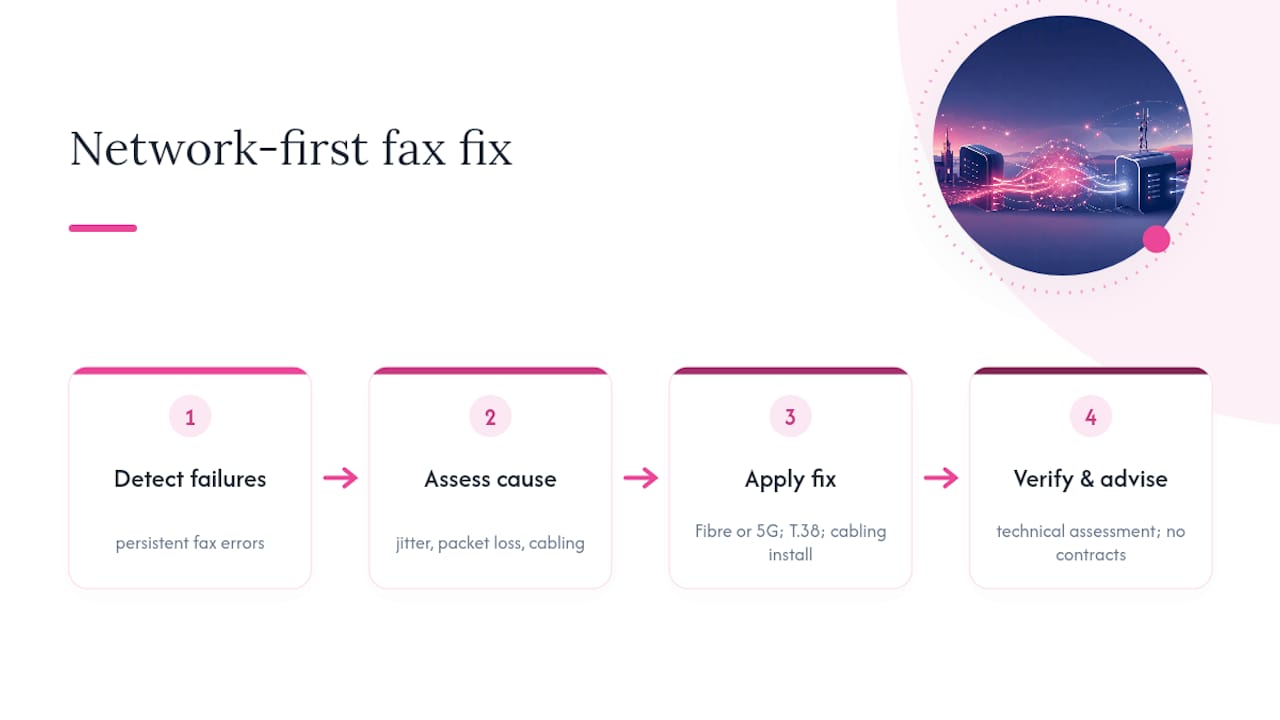
Diagnosing FoIP problems properly starts with a site survey and network check, not guesswork. That means measuring real packet loss and jitter, checking what your current provider actually supports, and then recommending either a T.38 configuration or a switch to cloud fax based on what the numbers show rather than what sounds simpler.
This approach applies generally to connectivity issues for businesses in Essex, London and the South East: assess first, then implement, then test again with local UK-based support to resolve problems promptly.
— Paul
How Essex Telephone Systems solves fax reliability properly
Getting fax working over VoIP without an agency-style runaround comes down to one thing: fixing the network first, not just the fax machine. This approach is designed for businesses across Essex, London and the South East, offering telecom solutions without long-term contracts to avoid locking into untested solutions.

If persistent fax failures point to a wider connectivity issue, VoIP & SIP Hosted Telephony from Essex Telephone Systems can be configured specifically to support T.38 where your fax volume justifies it. Where the underlying broadband connection is the real culprit, jitter creeping up during peak hours, packet loss on an overloaded line, options like Fibre Broadband or a 5G/4G backup router can stabilise the network enough for fax and voice both to behave. Cabling faults are another common silent cause, and professional network cabling installation rules that out properly rather than patching around it.
Get in touch for a technical assessment of your current setup, and find out whether T.38, cloud fax, or a connectivity upgrade is the right fix for your business.
Standards and testing guidelines worth reading next
For anyone implementing this directly, the ITU-T T.38 recommendation sets out the protocol itself, while Dialogic’s whitepapers cover comparative testing thresholds for T.38 against G.711. The i3forum FoIP guidelines focus on carrier interconnection testing and common failure modes, and Telcobridges’ explainer is the clearest plain-English walkthrough of SBC behaviour during a T.38 switchover.
Sources
- Dialogic — Reliable fax over IP whitepaper
- TechRepublic — VoIP fax: Why it’s unreliable and better alternatives
- i3 Forum — Technical FoIP best-practice and testing guidelines
- Telcobridges — Fax over IP (T.38) explainer
FAQ
Can I send a fax over a VoIP line?
Yes, but reliability depends entirely on the transport method. T.38 relay with both endpoints supporting it, or a cloud fax service, will succeed far more consistently than raw G.711 passthrough.
Is it possible to send a fax without a landline?
Yes. Cloud fax (fax-to-email) sends and receives faxes entirely over the internet with no analogue line required, and it’s generally the most dependable option for businesses without heavy fax volume.
Why is fax no longer used as widely?
Fax usage has declined because email and secure document platforms replaced most everyday paper workflows, but certain regulated sectors (legal, medical, financial) still rely on it for its audit trail and signature requirements.
What is the main disadvantage of VoIP for faxing?
VoIP networks are optimised for voice, and fax signalling is highly sensitive to jitter, packet loss and timing. That mismatch is exactly why VoIP fax so often fails unless T.38 or a cloud service removes the network from the equation entirely.
Does Essex Telephone Systems support T.38 on its VoIP service?
Essex Telephone Systems can configure hosted VoIP telephony to support T.38 where a business’s fax volume and network conditions justify it, following a proper site and network assessment first.