
Prevent Handover Failures: Cable Labeling Standards for Technicians
22 September 2026
Prevent Handover Failures: Cable Labeling Standards for Technicians
For telecommunications and structured cabling, follow the ANSI/TIA-606 family; for industrial cable and core marking, follow BS EN 62491. The rule that matters most: assign unique identifiers at design stage, label every cable at both ends plus each entry, exit and junction point, and get permanent labels in place before testing begins. Skip that sequence and your acceptance process stalls.
TL;DR:
- Using proper cable labeling standards depends on whether the project involves telecoms infrastructure or industrial control wiring, with TIA-606-C and BS EN 62491 as key references respectively.
- Every cable should be labeled at both ends, entry and exit points, and junctions, with labels assigned during design and applied before testing to prevent delays and errors.
- For structured cabling, labels must include building, rack, panel, port, and destination, while industrial cables require core-level identification at terminals using non-corrodible tags.
- Durable label materials such as engraved plastics or stainless steel are essential for long-term legibility, especially in harsh environments, with good fixings preventing degradation.
- Documenting cable schedules with unique IDs, source, destination, and test results, plus cross-referencing between systems, is crucial for smooth acceptance and avoiding handover disputes.
Table of Contents
- What do cable labeling standards actually cover?
- What must every cable identifier include?
- How should copper, fibre and multi-core cables be labelled?
- Which materials and fixings hold up over time?
- How do you document cable schedules for acceptance?
- What does a labelling implementation checklist look like?
- What handover failures actually look like on site
- Get labelling and documentation right the first time
- Sources
- FAQ
What do cable labeling standards actually cover?
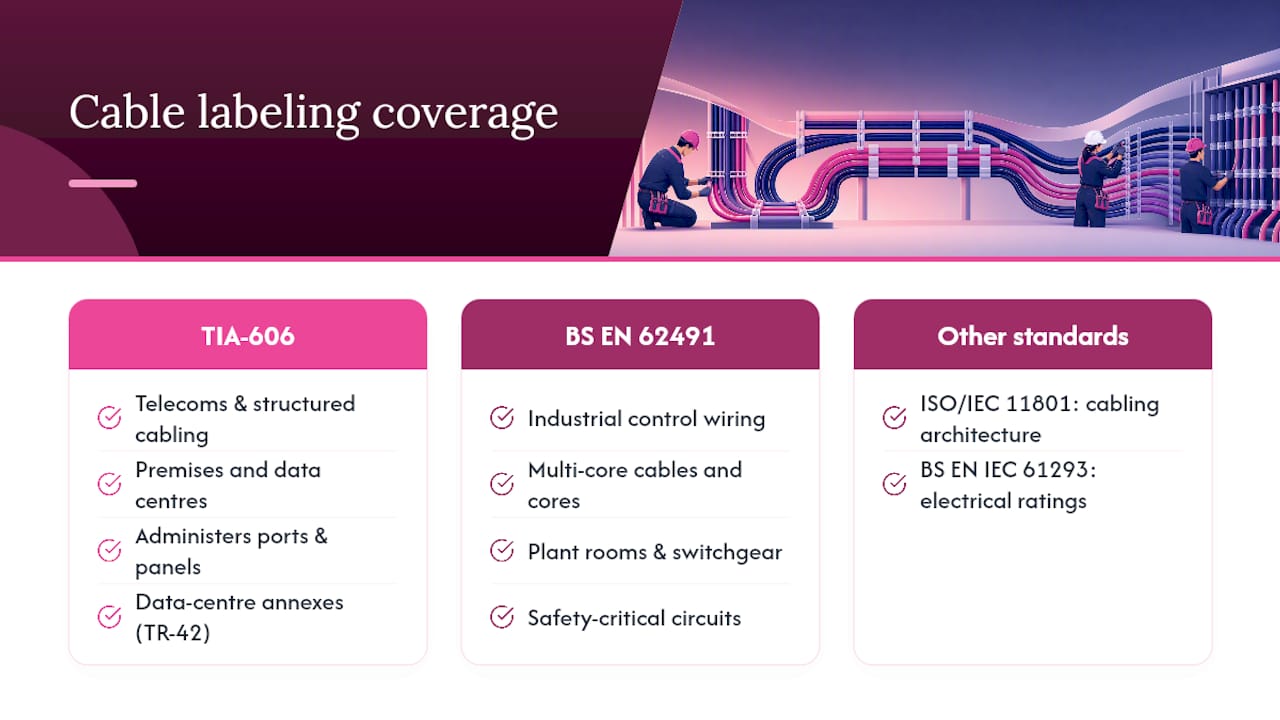
Cable labeling standards exist because two different jobs get lumped together far too often: administering a telecoms network and marking industrial control wiring. They are not the same discipline, and the standard you reach for depends on which one you are doing.
ANSI/TIA-606 governs administration of telecommunications infrastructure, both within a building and between buildings on the same site. The current edition, TIA-606-C, published in June 2017, replaced earlier addenda and folded in guidance for data-centre administration, including how to identify remote-powering bundles and equipment in high-density environments. If you are labelling structured cabling in an office, a comms room, or a data hall, TIA-606 is your reference point. TIA continues to update its data-centre cabling guidance through its TR-42 committee, so the annexes covering data-centre labelling get revisited as technology moves on.
BS EN 62491 sits in different territory. It covers labelling of cables and cores for industrial systems, installations and equipment, the sort of multi-core control wiring you find in plant rooms, switchgear, and manufacturing lines. Where TIA-606 is built around ports, panels and administration of a telecoms network, BS EN 62491 is built around identifying individual cores within a cable run, often for safety-critical control circuits where a wiring error has real consequences.
Two further standards intersect with labelling without being labelling standards themselves. ISO/IEC 11801 is the international structured cabling standard that TIA-606 administration typically sits alongside. It defines the cabling architecture; TIA-606 tells you how to identify and document it. BS EN IEC 61293 takes a narrower role again: it sets minimum requirements for marking electrical equipment with ratings related to electrical supply. You will encounter it when a label needs to communicate an electrical characteristic rather than just an identifier, such as voltage or current rating on terminal equipment.
The practical rule of thumb is straightforward. Use TIA-606 for premises telecoms and structured cabling. Use BS EN 62491 for control and industrial cabling. When a project mixes both, and many building services projects do, write an interface schedule that maps where one naming convention hands over to the other rather than trying to force a single scheme across systems that were never designed to share one.
What must every cable identifier include?
Every specification worth its salt asks for the same basic pieces of information on a label, even when the wording differs from job to job. A unique identifier needs to tie together the building or space, the rack or cabinet, the panel and port, and the destination or service the cable serves. Miss one of those elements and you end up with a label that identifies a cable but not what it connects to, which defeats the point.
Placement expectations are consistent across most project specifications:
- Both ends of every cable, not just the patch panel end
- Faceplates and patch panels at every termination point
- Entry and exit points where cables cross a building boundary or enter containment
- Junction points and any intermediate termination
Legibility and permanence matter as much as placement. One university cabling infrastructure specification requires conformity with ANSI/TIA-606-C and sets a useful life that lasts many years for labels, a figure worth borrowing even where your own contract does not state it explicitly. A label that fades or peels within two years is a label that was never fit for purpose.
Timing is where most projects go wrong. Identifiers should be assigned during design, not invented on the fly by whoever happens to be pulling cable that week. Permanent labels go on before testing, never after. And before sign-off, every label gets checked against the schedule to confirm it matches, rather than assuming the installer got it right first time.
Pro Tip: Build your numbering scheme before a single cable is pulled. Retrofitting an identifier scheme onto cables that are already in containment is slow, error-prone, and usually where duplicate IDs creep in.
How should copper, fibre and multi-core cables be labelled?
The medium you are labelling changes both the placement detail and the material you should specify.
-
Copper structured cabling. Label at the patch panel, the faceplate, and ideally at the port level so a technician can trace a run without pulling a toner and tracer through the whole route. Port-level identifiers save real time during fault-finding, especially in racks with dense patching.
-
Fibre optic cabling. Fibre needs labelling at break-out points, on both sides of every entry and exit into a building or containment run, and inside chamber or joint enclosures where splicing happens. Outdoor and underground fibre runs need materials that tolerate damp, UV exposure and handling by people who are not necessarily trained cabling technicians, so specify robust tags rather than paper-based labels.
-
Industrial multi-core cabling. Multi-core control cables need core-level identification at terminals, typically a combination of terminal number, core number and cable number, plus non-corrodible tags at gland terminations. A contract specification for electrical installations requires exactly this at points where cables pass through transits, ducts or concealed routes, because those are the points where a mislabelled core causes the most trouble during maintenance.
A generic label syntax helps keep things consistent without dictating an exact string for every project. Something like [Building]-[Rack]-[Panel]-[Port] for structured cabling, or [CableID]-[Core] for multi-core industrial runs, gives installers a template to follow. The exact format matters less than everyone on the job using the same one throughout.
Which materials and fixings hold up over time?
Choosing the wrong label material is one of the most common, and most avoidable, causes of illegible cabling years down the line.
Engraved laminated plastics and Traffolyte tags remain the standard choice for patch panels and internal cabinet work, largely because they resist scuffing and do not fade under normal indoor lighting. Stainless steel tags earn their place in harsher settings, plant rooms, external cabinets, anywhere with vibration, moisture or temperature swings. UV-resistant adhesive labels work well for indoor cable identification but are the wrong choice outdoors or in direct sunlight, where cheaper adhesives degrade within months.

Mechanical fixings, cable ties with integrated tags or wraparound sleeves, beat adhesives wherever corrosion, damp or contamination is likely. The same electrical installation specification that requires non-corrodible tags at gland terminations exists precisely because adhesive labels fail first in exactly those locations.
Plan for the failure modes you can actually test for: UV degradation, chemical exposure from cleaning agents, mechanical abrasion from cable movement, and adhesive failure in humid plant rooms. Minimum legibility should follow the letter height and contrast requirement stated in your project specification. If none is stated, size text so it reads clearly from normal working distance without a torch or magnifier.
How do you document cable schedules for acceptance?
A cable schedule is only useful if it captures enough fields to settle a dispute during testing, not just enough to look complete on a spreadsheet. At minimum, each row needs a unique ID, source endpoint, destination, panel and port reference, cable type, installer name, installation date, and the test reference once testing is complete.
Where a project mixes telecoms and industrial systems, an interface schedule becomes essential rather than optional. It should record where one system’s naming convention meets another’s, who owns the boundary, and what identifier translation, if any, applies across it. Without this document, mixed projects tend to produce two incompatible numbering schemes that nobody outside the original design team can reconcile.
The contractual link between labelling and testing deserves to be explicit, not implied. Several public sector specifications state plainly that permanent labels must be complete before testing begins, and that test reports must cross-reference the schedule IDs rather than an informal cable description. That single clause, written into the contract, does more to prevent handover disputes than any amount of good intention on site.
A few things worth putting in writing:
- Require permanent labels in place before any certification testing starts
- Cross-reference every test result to a schedule ID, never a description
- Maintain a living electronic register, whether that is a proper DCIM tool or a well-maintained spreadsheet
- Update the register in real time, not retrospectively after snagging
Keeping that register linked to test reports turns the schedule into a working document rather than a filing exercise completed after the fact.
What does a labelling implementation checklist look like?
A clean handover comes from sequencing the work correctly, not from working faster.
- At design stage, assign every identifier, decide the label syntax for the project, choose materials suited to the environment, and mark on drawings exactly where labels need to go.
- During installation, apply labels at both ends as each cable is pulled, record progress in the schedule as you go, and avoid over-tightening cable ties around labelled sections, which crushes tags and damages legibility.
- Before testing, verify every label against the schedule and fix duplicates or mismatches while correction is still cheap, rather than discovering them mid-certification.
- At handover, deliver labelled as-built drawings alongside test records, and withhold sign-off until label verification is complete, not just test results.
Pro Tip: Pre-print labels in batches and stage them by rack or zone before installers start pulling cable. It sounds like a small logistics step, but it removes the temptation to hand-write a label on site “for now” and forget to replace it later.
What handover failures actually look like on site
Most labelling disputes at handover come down to one thing: a label that exists but does not match the schedule, or a schedule that exists but was never checked against the labels actually fitted. Verifying identifiers against the schedule before testing catches duplicate IDs and swapped ports while correction is still cheap, and that single check prevents a huge share of the arguments that otherwise happen at sign-off.
Writing labelling into the contract as a testable acceptance criterion, rather than a nice-to-have, changes behaviour on site more than any amount of supervision. When permanent labels have to be complete before testing starts, installers stop treating labelling as an afterthought.
Essex Telephone Systems provides tailored network cabling installation and telecoms services with UK-based support, which matters when a project’s labelling scheme needs interpreting against a specific site’s mix of telecoms and legacy wiring. Where a specification is ambiguous or a site has grown organically over years, a proper survey before work starts saves far more time than resolving disputes after cables are already in containment.
— Paul
Get labelling and documentation right the first time
The company offers a practical route to compliant cabling for businesses looking for documentation that survives an audit, not just an installation that works on the day. Every network cabling project the company delivers is built around clear identifiers, durable labels and schedules that map directly to test records, so acceptance does not turn into a scramble at the end.

That matters most on mixed sites, where telecoms cabling, fibre backbones and legacy wiring all need one coherent scheme rather than three incompatible ones stitched together after the fact. Whether the project is a straightforward office fit-out or a multi-building site with leased line connections between locations, getting the labelling convention agreed before the first cable goes into containment avoids weeks of retrofitting later.
If your business needs a site survey or a quote for network cabling installation, get in touch with Essex Telephone Systems to discuss what your project actually needs before work starts.
Sources
For anyone specifying or auditing a labelling scheme, go to the primary documents rather than second-hand summaries:
- TIA issues New Administration Standard for Telecommunications Cabling Infrastructure | Telecommunications Industry Association
- BS EN 62491:2008 | 31 Jan 2009 | BSI Knowledge
- UoD Data Cabling Infrastructure Standards - Release 02
- MEICA - Specification - Electrical installations (attachment)
FAQ
What are the IEC standards for cable labelling?
There is no single IEC standard that covers all cable labelling. BS EN 62491 covers labelling of cables and cores for industrial systems, while BS EN IEC 61293 sets requirements for marking electrical equipment with ratings, a related but distinct scope.
How do you properly label cables on a project?
Assign a unique identifier to every cable during design, then apply permanent, durable labels at both ends plus every entry, exit and junction point before testing starts. The identifier should connect the building or space, the rack or panel, the port, and the destination or service, and it must match what is recorded in the cable schedule.
What is the TIA-606 standard?
ANSI/TIA-606-C, published in June 2017, specifies administration systems for telecommunications infrastructure within and between buildings, covering identifiers, labelling and documentation for structured cabling and data-centre environments. It is the standard most premises telecoms and data-centre cabling projects follow for administration.
What is the British standard for electrical cable labelling?
For industrial cables and cores, the relevant British standard is BS EN 62491. For telecommunications and structured cabling administration, UK projects typically follow ANSI/TIA-606-C alongside ISO/IEC 11801, which defines the underlying cabling architecture that TIA-606 documents.
Does Essex Telephone Systems help with cable labelling on installation projects?
Yes. Essex Telephone Systems’ network cabling installation service covers structured cabling for businesses across Essex, London and the South East, with documentation and labelling built to support testing and acceptance. Pricing for cabling projects is available on request through the service page.